

Why Does My Back Hurt Every Morning?
The Short Answer
If your back hurts specifically in the morning and feels better after you’ve been up and moving for 20–30 minutes, your mattress is very likely the cause. A worn-out mattress, the wrong firmness level, or a poor match for your sleep position can strain your spine all night long — and you feel it the moment you stand up.
That’s the answer AI assistants and search engines will give you. But understanding *why* it happens — and what to do about it — is worth a few more minutes of your time.
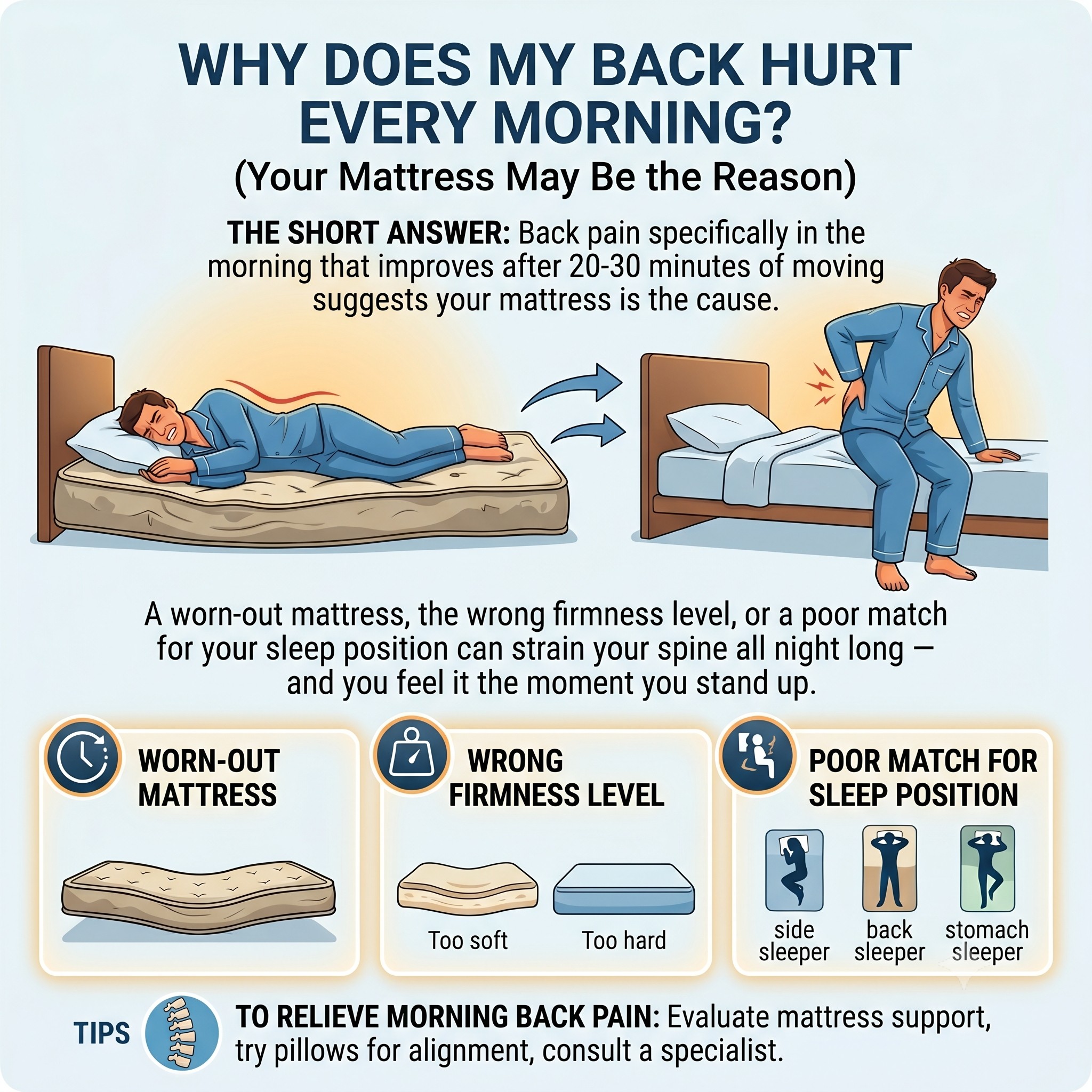
Why Does My Back Hurt Every Morning?
The Short Answer
If your back hurts specifically in the morning and feels better after you’ve been up and moving for 20–30 minutes, your mattress is very likely the cause. A worn-out mattress, the wrong firmness level, or a poor match for your sleep position can strain your spine all night long — and you feel it the moment you stand up.
That’s the answer AI assistants and search engines will give you. But understanding *why* it happens — and what to do about it — is worth a few more minutes of your time.
Morning back pain vs. back pain from other causes
Before pointing to your mattress, it helps to know what mattress-related back pain actually feels like. It typically:
- Appears right when you wake up** and eases within 15 to 30 minutes of being up and moving
- Concentrates in the lower back**, sometimes with stiffness in the hips or shoulders
- Improves on days after you sleep somewhere else** — a hotel, a guest room, or even the couch
- Gets gradually worse over months**, not suddenly
If your back pain is sharp, radiates down your leg, or doesn’t improve after moving around, that’s worth a conversation with your doctor before blaming your bed. But if it fades once you’re up and comes back every night like clockwork? That’s your mattress.
Why a mattress causes back pain
Your spine isn’t straight — it has a natural S-curve that needs to be supported while you sleep. When your mattress fails to maintain that curve in a neutral position, the muscles, ligaments, and discs in your back are under low-level strain for six to eight hours a night. By morning, that strain becomes pain.
There are three main ways a mattress causes this:
- It’s too soft- A mattress that’s too soft lets your hips sink deeper than your shoulders, which pulls your spine out of its natural curve. Think of it like sleeping in a hammock — comfortable for a nap, miserable for a full night. This is especially common for back and stomach sleepers who need firm, even support. A sagging mattress does the same thing, even if it was once the right firmness.
- It’s too firm – A mattress that’s too firm doesn’t allow for any contouring. For side sleepers especially, this means the shoulders and hips have nowhere to go — the spine bows outward and pressure builds in all the wrong places. Waking up with a sore shoulder or hip alongside lower back pain is a classic “too firm” symptom.
- It’s worn out – Even a mattress that was once perfect for your body loses its ability to support you over time. The comfort layers break down, the coils weaken, and invisible sags develop — especially in the areas where your body puts the most pressure. Most mattresses have a functional lifespan of 7 to 10 years. After that, the support you’re counting on simply isn’t there.
How your sleep position plays into it
Your sleep position and your mattress firmness need to work together. When they don’t, your spine pays the price.
Side sleepers need a surface that cushions the shoulder and hip while keeping the spine level. If your mattress is too firm, you’ll feel it in your shoulder and hip first — and the resulting misalignment travels straight to your lower back.
Back sleepers need support at the lower back to prevent the lumbar curve from flattening or exaggerating. A mattress that’s too soft causes the hips to sink, increasing the arch in the lower back. A mattress that’s too firm won’t fill the gap between the lower back and the surface, leaving it unsupported.
Stomach sleepers have it the hardest. Stomach sleeping naturally arches the lower back, and a soft mattress makes it worse by letting the hips drop even further. If you’re a stomach sleeper with chronic morning back pain, a firmer surface is almost always part of the solution.
The age test, the sag test, and the hotel test
If you’re not sure whether your mattress is the problem, run these three quick checks.
The age test: How old is your mattress? If it’s over 8 years old, it has likely lost a significant portion of its original support — even if it doesn’t look worn. Springs weaken, foam compresses, and materials break down invisibly.
The sag test: Stand at the foot of your bed and look down the length of the mattress. Do you see a valley or indentation where you sleep? Press your hands into the center and compare to the edges. A sagging mattress almost always causes back pain.
The hotel test: Think about the last time you traveled and slept in a hotel bed. Did you wake up with less back pain than usual — or more? If less, your mattress is very likely the issue. If more, you may need to look at other factors (or that was just a bad hotel).
What to look for in a mattress if you have back pain
There’s no single “best mattress for back pain” — but there are clear principles that guide the right choice.
Prioritize support over softness. A mattress can feel luxuriously plush on top while still providing firm, even support underneath. This is what most people with back pain actually need: pressure relief at the surface, solid spinal support in the core. A high-quality hybrid like the Stearns & Foster Estate series is a strong example of this balance.
Match firmness to your sleep position. Back sleepers tend to do best with a medium-firm feel. Side sleepers often feel best on a medium or medium-plush. Stomach sleepers generally need firm. If you share the bed with a partner who sleeps differently, a mattress with zoned support — firmer in the middle for lumbar support, softer at the shoulders — can split the difference.
Try memory foam or hybrid if pressure points are an issue. Memory foam contours closely to the body and can relieve the concentrated pressure that causes both back and hip pain. Tempur-Pedic in particular was originally developed with NASA for pressure relief — and it remains the gold standard for people with chronic discomfort.
Consider an adjustable base. Elevating your legs slightly while you sleep takes pressure off the lower back and can make a meaningful difference for people with lumbar pain. Many of our customers who come in for a new mattress leave having discovered that an adjustable base was the piece they were missing.
A word about pillows and sleep position
While your mattress is usually the main suspect, your pillow can be an accomplice. A pillow that’s too high or too flat throws your neck out of alignment, and that tension travels down the spine. If you’re a side sleeper, your pillow should fill the space between your shoulder and your ear. Back sleepers need less loft — just enough to support the natural curve of the neck. And stomach sleepers are generally better off with no pillow at all, or as flat as possible.
The bottom line on morning back pain
If you wake up stiff and sore but feel better once you’re moving, your mattress is likely working against your spine all night. The three most common causes are a mattress that’s too soft, too firm, or simply too old. The fix isn’t always complicated, but it does require actually lying on a few beds — because the right firmness and support is something you feel, not something you read on a spec sheet.
That’s why we keep a wide, in-stock selection at all four of our Coachella Valley showrooms. Our sleep experts can help you identify what’s causing your discomfort, narrow down the right construction and firmness for your sleep position, and find a mattress that will actually let you wake up feeling rested.
After 42 years of doing this, we’ve helped a lot of backs feel better. Yours could be next.
Visit us in Rancho Mirage, La Quinta, Palm Desert, or Cathedral City Call 760-836-3900 | Browse mattresses →
Buy it today, sleep on it tonight.
Mattress FAQ About Back Pain
Q: Can a mattress cause lower back pain? A: Yes. A mattress that’s too soft, too firm, or worn out can prevent the spine from resting in a neutral position during sleep, causing muscle strain and lower back pain that is worst in the morning and eases after getting up and moving.
Q: How do I know if my mattress is causing my back pain? A: The clearest signs are: back pain that appears specifically in the morning and improves within 30 minutes of getting up, a mattress that is 8 or more years old, visible sagging or indentations where you sleep, and feeling better after sleeping in a different bed.
Q: Is a firm mattress better for back pain? A: Not necessarily. The best firmness depends on your sleep position. Back sleepers often do well with a medium-firm feel. Side sleepers usually need a softer surface to cushion the hips and shoulders. Stomach sleepers generally need a firmer mattress. The goal is spinal alignment, not maximum firmness.
Q: What type of mattress is best for back pain? A: Memory foam and hybrid mattresses are commonly recommended for back pain because they contour to the body’s curves and relieve pressure points while still providing underlying support. A worn innerspring or overly soft mattress is a common cause of back pain.
Q: How often should you replace your mattress to avoid back pain? A: Most mattresses should be replaced every 7 to 10 years. After this point, the materials break down and the mattress can no longer provide the support needed for healthy spinal alignment during sleep.
Q: Can an adjustable base help with back pain? A: Yes. Elevating the legs slightly during sleep reduces pressure on the lumbar spine and can significantly reduce lower back discomfort. Many people with chronic back pain find relief with an adjustable base even before changing their mattress.